


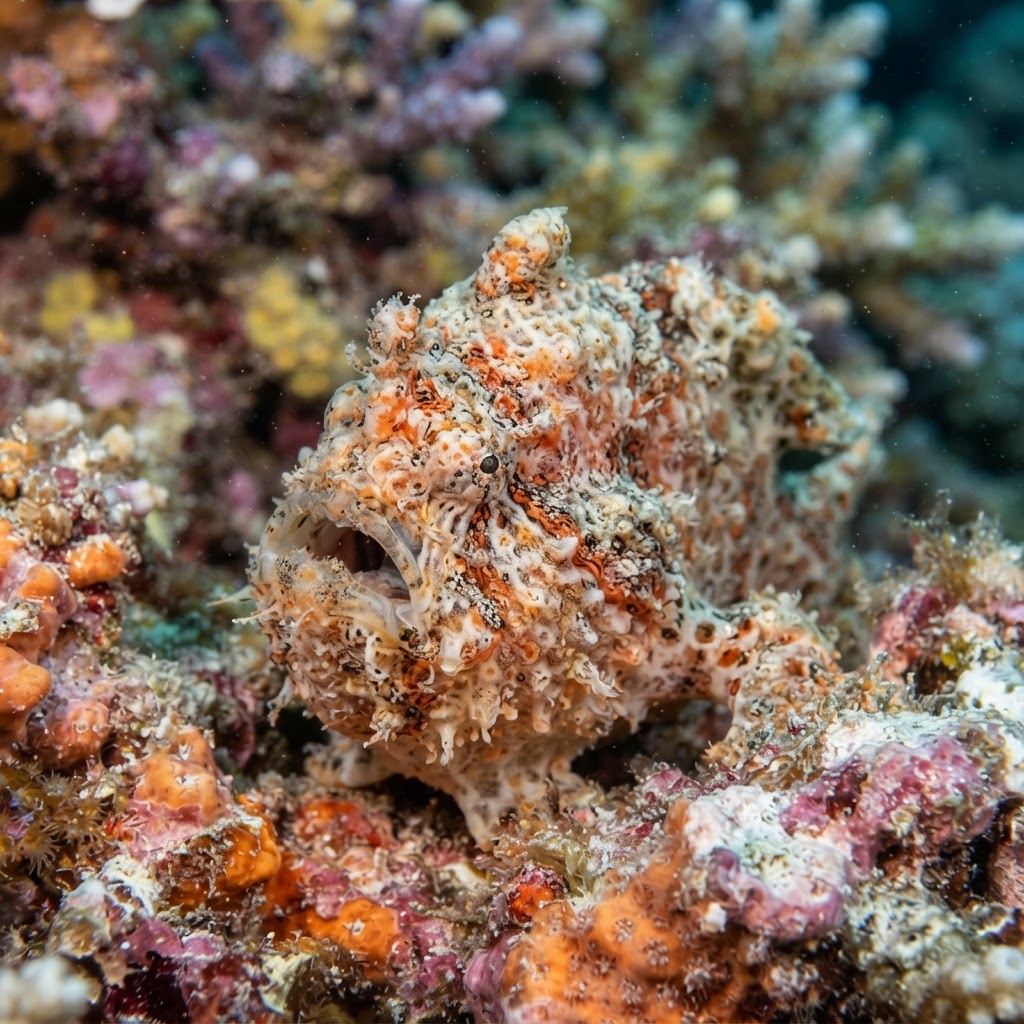
The Hawaiian Frogfish: The Reef's Most Bizarre and Beautiful Ambush Artist
I have a confession to make.
I have swum past frogfish hundreds of times without seeing them. I know this because on certain dives, a more experienced naturalist has stopped me, pointed at a sponge-encrusted rock, and said "look closer."
And there — somehow — is a face looking back at me.
The frogfish. The reef's best practical joke.
Built Wrong, Works Perfectly
The Hawaiian frogfish (Antennarius spp.) is, from a purely aesthetic standpoint, a mess. Lumpy, asymmetrical, covered in wart-like protuberances, often splashed in wildly impractical colors. Bright yellow. Hot pink. Deep maroon. Occasionally all three.
And yet every single element of that apparent chaos is precision engineering.
The lure: Frogfish possess a modified dorsal spine called an illicium — a fishing rod, basically — tipped with a fleshy, worm-like or shrimp-like lure called an esca. The frogfish twitches this lure in front of its face to attract prey. When something comes to investigate, the frogfish opens its mouth — one of the largest mouth openings relative to body size in the animal kingdom — and the resulting suction vacuum inhales the prey whole in approximately 6 milliseconds. Faster than a blink. Faster than most cameras can capture.
The camouflage: Frogfish can change color slowly over days to match their surroundings. They often attach themselves to sponges of matching color and sit absolutely, perfectly still. They don't swim away from approaching divers because they don't need to — if you can't see them, they're safe.
The walk: Frogfish don't swim normally. They use their pectoral fins — modified into something that functions like legs — to walk across the reef. They also use jet propulsion, gulping water and expelling it through small gill openings to move in bursts when necessary. Watching a frogfish walk is one of the most surreal moments available on any reef.
Finding Frogfish at Kewalo Basin
Frogfish are present at Kewalo Basin year-round, but finding them requires the right combination of experience and patience. They favor:
- Sponge-covered surfaces — especially orange and yellow sponges where they can color-match
- Rubble zones — the transition between coral and sandy bottom
- Ledge undersides — where their downward-facing posture looks most natural
The best frogfish spotter at Hawaii Dive Center is your dive guide — our naturalist team knows the specific spots where individuals have been living for months or years. Frogfish are territorial and site-faithful; find one, and it'll likely be there on your next dive too.
Why They Matter
Beyond their entertainment value, frogfish are indicators of reef habitat diversity. Their presence signals healthy sponge communities and complex reef structure — conditions that the broader reef ecosystem depends on.
At Kewalo Basin, our DLNR DAR surveys document frogfish sightings as part of broader biodiversity monitoring. Tracking cryptic species like frogfish over time reveals changes in habitat quality that other survey methods might miss.
See One on Your Next Dive
Ask your HDC guide to find you a frogfish. Fair warning: once you know how to see them, you'll never be able to unsee them — and every "sponge" on every future dive will get a second look.
Book your charter at hawaiidivecenter.app. The frogfish has been waiting, perfectly still, since last Tuesday. 🌊
Take the Next Step
Experience It For Yourself
Hawaii Dive Center is a 501(c)(3) non-profit. Every booking directly funds coral restoration, citizen science, and marine education in Hawai'i.
Book OnlineYou Might Also Like
Stories from Below the Surface
Dive education, marine conservation insights, local guides, and stories from Hawaii's underwater world — written by our instructors and conservation team.
Browse Articles
Ready to Dive In?
Turn Reading Into Action
Every article you read here represents a real dive, a real reef, and real conservation impact. Join us in the water and become part of the story.
Book Now